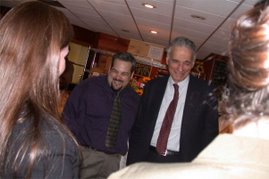
The State Green Party invited me to attend a press conference in Albany to respond to Governor Patterson's State of the State. Here is a link to WNYT's coverage and below is a text copy of my remarks.
http://wnyt.com/article/stories/S735158.shtml?cat=10114
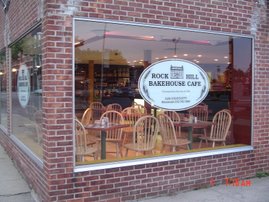
My name is Matt Funiciello. I am the owner of a bread bakery and cafe in Glens Falls, N.Y. I currently employ 36 people. I am here today to deliver my own brief state of the state from a small business owner’s perspective. This is not the perspective of a lobby group purporting to represent small business. It is the perspective of someone who has actually run a small business in New York state for over 20 years.
As this economic downturn began, small business owners, like the majority of Americans, saw substantial increases in energy costs and commensurate increases in most other goods and supplies. In my industry, we were already struggling with the negative impact of increasing wheat prices as corn subsidies encouraged many wheat farmers to grow corn for ethanol. This created a terrible “food for fuel” quandary in which the corn lobbies seem to have been the only clear winners.
While our costs have steadily increased so has the cost of living for our workers. Even so, we have not been able to make pay increases to keep up with cost of living as our sales have been in decline. We were actually forced to implement a small pay cut in September of 2008 and I was eventually forced to sell my home and borrow a substantial sum of money to keep my business afloat as the year progressed and we suffered the additional negative effects of a fire.
We ceased carrying health insurance about a year ago as costs skyrocketed along with co-pays and pharmaceutical prices. We had to discontinue our retirement plan as we were no longer able to afford to participate in it. Many of our restaurant and retail accounts have been adversely affected as well by decreased consumer spending. Several long-time customers have even thrown in the towel.
I say all of this not as some kind of litany of woes but as an example of what the typical business owner is actually going through. We are a tough bunch and we will make it but, make no mistake, we are hurting. If you wish to understand the direct impact the recession is having on those in the working and middle class, look no further. We have tightened our belts, cut costs and minimized our needs, but we are still prepared to sacrifice more if we have to. We would, however, like to know that every single person in the state is joining with us in this suffering and sacrifice and that we are not being asked to shoulder the burden entirely.
Governor Patterson said yesterday that, “We cannot solve our problems overnight or without sacrifice - they run too deep for that. These problems may last for many more months or even years. But we can solve them and, with courage, we can craft a brighter, smarter future for New York.”
I agree with those sentiments, but I think we need to put a little bit of common sense in there before we continue with the sacrifice.
I don’t know about your economy but bailing out banks and insurance companies seems to have had very little impact on mine, thus far. I know that the Wall Street bailout was hardly Governor Patterson’s doing but I know that it is a perfect example of why we HAVE to find answers at the state level for the problems of the day. We simply cannot depend on the federal government to do what is right or just when things are broken.
If we leave it up to the fed or follow their lead, the problems New Yorkers are now facing will go unsolved. The biggest problem, without any doubt, is health care. In fact, according to a recent survey conducted by the Business Council of NY, health care is the single biggest issue for business owners in New York State. Worker’s comp rates came in a distant second.
Governor Patterson says we “need the courage to balance our budget as well as our priorities.” Well, he is absolutely right and small business has spoken loudly about the priority; it is health care. The question becomes, How do
we balance our budget while insuring the millions of New Yorkers who lack coverage?
I know the answer and, in reality, so does the Governor. That’s why I was absolutely horrified yesterday to see him openly advocate for more bureaucratic and incremental answers to our health care crisis rather than the sweeping reform we so desperately need.
Where health care is concerned, there is one clear answer and it is Single-Payer Health Care. It is basically the Canadian Health Care system with a few twists. It’s a clear and intelligent answer to a pressing problem. The Governor’s advocacy for building additional bureaucracies in our state with substandard care and inconsistent access is not such an answer. We need to get rid of the HMO’s and administrate our state’s health care through one mechanism instead of the hundreds that currently exist. It is projected that just that one bold move would save us 25-30% of what we currently pay for health care.
The Canadian system costs about $5200 per person with universal coverage and if you question its efficiency, you should know that, propaganda aside, Canadians live a full year longer than we do. You should also know that no sober, literate, Canadian would even consider switching health plans with anyone living in the U.S. unless they were forced to at gunpoint.
Here, in the U.S., we spend about $7200 per person on health care. Bear in mind that this is with about 60 million people completely uncovered and another 50 million or so ‘underinsured’. With all the layoffs projected from the recession, these numbers will increase dramatically. The incredible truth is that if we adopted Single-Payer Health Care in this country, we would actually be spending far less on care and everyone would be covered. It’s really a common sense approach to the problem.
Thanks to John Conyers and Denis Kucinich, there is already a resolution before congress, HR 676, which does have sponsors, but we need to be realistic about its chances in Washington. The resolution is unlikely to pass. There is simply too much HMO and pharmaceutical money floating around the Capitol for our public servants to do what is just. Many people think of my congresswoman, Kirsten Gillibrand, as a progressive of some kind. She, just like Barack Obama, and now New York’s Governor, has refused to discuss single payer at any level and has refused to support HR 676 even though she knows it is the best, most economical answer.
With our federal representatives doing such a poor job of representing us, we need Governor Patterson to help us resolve this issue right now, right here at home. We can have a single-payer system right here in New York state. We are projected to spend some $140 billion dollars in this state on health care in 2009. If we were to set up a single-payer health plan and spend a similar amount to what the Canadians do per capita, we would be saving $1,800 per person over what is already being spent with EVERY New Yorker covered. Who knows? Maybe we could start living a year longer, too!
Governor, business leaders are telling you that health care is the single biggest issue on the state's agenda but we can also tell you that there is a simple solution. Now is the time for our state government to implement solutions that actually make sense and not just those that seem politically feasible. We have suffered enough. Our workers have suffered enough. How, as a state, can we lose? How can it not make sense to save boatloads of money during a recession while ensuring that every citizen of New York has total access to health care?
The Governor called this recession “the gravest economic challenge in nearly a century.” Well, it seems to me that it really doesn’t have to be if we can just make decisions together which benefit everyone in our state and not just special interest groups and lobbies. Please, Governor Patterson, do what is right and support single-payer health care. Support common sense
Showing posts with label governor. Show all posts
Showing posts with label governor. Show all posts
Friday, January 9, 2009


Friday, June 8, 2007
Walking The (Green) Walk
Living up to all of the tenets of the Green Party would be a tall order. We are friends of the environment and alternative energy. As such, we should all be living in small, ecologically-sound, passive solar homes. Are we? I would hazard a guess that most of us aren’t. We preach about global warming and vastly decreasing our country’s insane energy consumption. While many of us do own hybrids, walk, ride our bikes or take alternative transportation, as a group, we are still burning plenty of fossil fuels. We talk about the need for local food and the building of local economies. We talk about the need to fight corporate power and agribusiness. As such, we should all feel massive twinges of guilt at the supermarket even while filling our carts with “faux organic” produce often produced thousands of miles away on factory farms. In short, while it seems that most Greens make an effort we are probably still falling far short of really changing the landscape. That puts us in the same boat as everyone else in this country.
Green business owners are an interesting sub-group within the party. We are in a unique situation to act as Green representatives as the public may be more likely to see our efforts to push forward new thought processes about lifestyle and new alternatives to corporate politics. As a Green business owner myself, I spend an inordinate amount of time contemplating this subject. Am I uniquely positioned as a Green business owner (if at all) to help grow awareness of the party and to help foment Green change? How can I best serve the interests of our party? How can I use my heightened prominence in our community to “walk the Green walk” and help represent the party’s ideals and vision?
Since first registering as a Green over a decade ago, I’ve struggled with the lonely feeling that I am the only Green business owner in America. I know that this is far from true. I’m sure there are actually many of us but we are not the sort to be too candid about our business dealings. We are untrusting of this bureaucratic and somewhat dysfunctional group that serves as our political home. When Peter Camejo ran for VP in 2004, I was thrilled. I immediately read his book on SRI (socially responsible investing and saw that one can be a successful capitalist (albeit a socially conscious one) and also be openly Green. Peter’s example was truly an inspiration to me.
I own and run Rock Hill Bakehouse, a wholesale bread bakery in upstate New York. We pay everyone who works for us a living wage and we do our level best to provide the best benefits that can be afforded in our market. We use local and organic ingredients in our breads and foods whenever possible and have been instrumental in creating a demand for locally-grown and milled grains and flours. We use fair trade coffees roasted locally. We use organic teas from our local self-titled “Tea Maven“. The majority of our produce is local and we sell our breads at over a dozen farmer’s markets (many in new York City). My father raises free range chickens on his farm and we use their meat to make our popular curried chicken salad. We use beef from a small farm about twenty minutes away as often as it is available. Ingredients that cannot regularly be sourced locally are purchased from local distributors who have made a commitment to paying their employees a living wage and to buying local wherever possible. In short, we try really hard and we are always trying to build more and better relationships to tweak the formula.
As with most good Greens, I am also an activist. I have been very outspoken on important issues in our area and have become somewhat of a spokesperson for the Greens locally (letters to the editor, Indy media booster and protest and event organizer). Contrary to conventional wisdom, I have found that the cost of being outspoken has been minimal (if there is really any “cost” at all).
I did once have a Vietnam Vet come to my café from the area VFW to let my customers know from the bed of his pickup with a bullhorn that I “didn’t support the troops”. A handshake and an hour spent in conversation was all it took for this man to see that my problem with our occupation of Iraq is a problem with war in general and the military industrial complex and not with our economically-conscripted, working class, soldiers.
I have hosted visits by Ralph Nader twice to our area in the last three years and while some people have shaken their heads at me for doing do, they usually do it while ordering food. A larger number have thanked me and a larger number still couldn’t care less (its them I need to work on). I advertise in local Indy papers, usually putting controversial comments and political advice in my print ads). Only a few times have callers left messages that they would “never buy bread from a commie” or other such anonymous venom. My business has grown every year for the last ten years and, as such, I can’t believe that my being Green has ever hurt my business in any way.
David Doonan, a good friend of mine, runs Mohill Design, a freelance web design company in Greenwich. He has worked for himself since August of 2001. He does a lot of pro bono work for the Green Party and has also designed more than a few web sites for our candidates (including Howie Hawkins when he ran against Hillary Clinton last year). David writes for several Indy media papers and is a photographer who has faithfully chronicled many peace actions and protests against this war and others.
I asked Dave what its like to be a Green business owner in small town America. He relates that when he and his wife first moved up from New Jersey fifteen years ago, “If you wanted anything done, you had to be a Republican. You had to be quiet. You couldn’t put your name and your politics out there. I don’t know that this is the case now because when the town needed a website, I was the guy who got the job.”
Doonan recently accepted a board position with the local Chamber of Commerce. He says that things can seem somewhat “schizophrenic” being involved in activist and social justice circles and at the same time being involved in fairly conservative business circles. I am the same way and I know what he means. We also talked about using foreign goods in our businesses. It is often difficult to buy products that are domestic and that truly support proper labor practices and environmental law. I asked David if its possible to get around the cheap (almost exclusively foreign) hardware and technology that drives the internet boom his business so depends on. He says that if it weren‘t for said equipment he “would probably be working 40 or 50 hours a week for someone else instead of for myself.” Rather than feeling like a hypocrite, he simply uses that knowledge as fuel that drives him to offset that somewhat mandatory compromise by doing good progressive work to make up for it, primarily his photographic record of activist activity in an ever- increasing radius.
Mohill Design “recycles paper and turns the lights off.” The client list is almost entirely made up of local people and businesses that are within walking distance of his modest home office. I ask if he has ever seen any “blowback” as a result of his political work. He relates that he did have one client who was deeply offended by a link David sent out showing photos he had taken of an anti-war march in Washington. That’s probably the only client he feels he’s lost, though.
High Peaks Java is a small coffee roasting company and café run by Derek Java (that is his real name). He uses only fair trade, organic coffee beans and offers soy and organic dairy products. Java says that he “held most of his ‘Green’ opinions and values prior to becoming a Green about a year ago”. Derek says that he doesn’t really know if being a Green affects his standing in the business community because he doesn’t really get much feedback about it. He doesn’t hide who he is but he also says that he doesn’t necessarily project it either. “If anybody were to come into my shop, they would see a poster of Ralph Nader on the wall and … they can draw their own conclusions or they can ask me a question. Most of them draw their own conclusions.”
Java says that prior to becoming an enrolled Green, he was already trying to “walk the green walk”, as he puts it. Now that he is enrolled he says he does feel that its even more important to set the standard for others to follow. While “greening” his business was not an unwieldy task, as it was pretty much already done before he registered, but he now sees the need to help others see how they can do the same.
We discuss our mutual awareness of how limited financial resources are within the party and I ask him if he thinks that we (as Green business owners) should focus on becoming a better, more organized force within the party so that we can help financially support party growth on a state and national level.
“I think its absolutely the way Greens should go. The problem comes when you start thinking about levels of donation per individual and how to compete on a national basis against two players (the corporate parties). They set the playing field ridiculously high. I mean the major forerunners in this election will raise a half a billion dollars! 500 million dollars in eighteen months! I won’t raise that in my life. To compete at that level … the way to reach those people is through advertisement and … advertisement’s expensive, perhaps more expensive than can be managed with a maximum donor value.”
We talk about Green business changing the perception of what it is to be a business person. Green businesses can help get the message out by showing people who come into contact with them an alternative to modern corporate behavior and structure. Java says he is interested in seeing Green businesses throughout the country help get the message out by advertising directly about Green candidates and issues.
There seems to be agreement that, as a caucus within the party, it would be good to start a meaningful discussion about how best to utilize the unique skills and resources we bring to the Green table. We all seem to share the hope that, over time and with our assistance, the party can attract other entrepreneurs and business owners into the fold. We feel a new example can be set as to what “business” is and what it looks like when a moral compass and a little vision are added to the mix. We all talked about our desire to see a network form that would take stock of Green business owners nationwide and help Greens with resource network with each other to help grow the party.
If you are interested in helping to form such a group or caucus please contact me at the email address below and we‘ll get to work. mattfuniciello@earthlink.net
Green business owners are an interesting sub-group within the party. We are in a unique situation to act as Green representatives as the public may be more likely to see our efforts to push forward new thought processes about lifestyle and new alternatives to corporate politics. As a Green business owner myself, I spend an inordinate amount of time contemplating this subject. Am I uniquely positioned as a Green business owner (if at all) to help grow awareness of the party and to help foment Green change? How can I best serve the interests of our party? How can I use my heightened prominence in our community to “walk the Green walk” and help represent the party’s ideals and vision?
Since first registering as a Green over a decade ago, I’ve struggled with the lonely feeling that I am the only Green business owner in America. I know that this is far from true. I’m sure there are actually many of us but we are not the sort to be too candid about our business dealings. We are untrusting of this bureaucratic and somewhat dysfunctional group that serves as our political home. When Peter Camejo ran for VP in 2004, I was thrilled. I immediately read his book on SRI (socially responsible investing and saw that one can be a successful capitalist (albeit a socially conscious one) and also be openly Green. Peter’s example was truly an inspiration to me.
I own and run Rock Hill Bakehouse, a wholesale bread bakery in upstate New York. We pay everyone who works for us a living wage and we do our level best to provide the best benefits that can be afforded in our market. We use local and organic ingredients in our breads and foods whenever possible and have been instrumental in creating a demand for locally-grown and milled grains and flours. We use fair trade coffees roasted locally. We use organic teas from our local self-titled “Tea Maven“. The majority of our produce is local and we sell our breads at over a dozen farmer’s markets (many in new York City). My father raises free range chickens on his farm and we use their meat to make our popular curried chicken salad. We use beef from a small farm about twenty minutes away as often as it is available. Ingredients that cannot regularly be sourced locally are purchased from local distributors who have made a commitment to paying their employees a living wage and to buying local wherever possible. In short, we try really hard and we are always trying to build more and better relationships to tweak the formula.
As with most good Greens, I am also an activist. I have been very outspoken on important issues in our area and have become somewhat of a spokesperson for the Greens locally (letters to the editor, Indy media booster and protest and event organizer). Contrary to conventional wisdom, I have found that the cost of being outspoken has been minimal (if there is really any “cost” at all).
I did once have a Vietnam Vet come to my café from the area VFW to let my customers know from the bed of his pickup with a bullhorn that I “didn’t support the troops”. A handshake and an hour spent in conversation was all it took for this man to see that my problem with our occupation of Iraq is a problem with war in general and the military industrial complex and not with our economically-conscripted, working class, soldiers.
I have hosted visits by Ralph Nader twice to our area in the last three years and while some people have shaken their heads at me for doing do, they usually do it while ordering food. A larger number have thanked me and a larger number still couldn’t care less (its them I need to work on). I advertise in local Indy papers, usually putting controversial comments and political advice in my print ads). Only a few times have callers left messages that they would “never buy bread from a commie” or other such anonymous venom. My business has grown every year for the last ten years and, as such, I can’t believe that my being Green has ever hurt my business in any way.
David Doonan, a good friend of mine, runs Mohill Design, a freelance web design company in Greenwich. He has worked for himself since August of 2001. He does a lot of pro bono work for the Green Party and has also designed more than a few web sites for our candidates (including Howie Hawkins when he ran against Hillary Clinton last year). David writes for several Indy media papers and is a photographer who has faithfully chronicled many peace actions and protests against this war and others.
I asked Dave what its like to be a Green business owner in small town America. He relates that when he and his wife first moved up from New Jersey fifteen years ago, “If you wanted anything done, you had to be a Republican. You had to be quiet. You couldn’t put your name and your politics out there. I don’t know that this is the case now because when the town needed a website, I was the guy who got the job.”
Doonan recently accepted a board position with the local Chamber of Commerce. He says that things can seem somewhat “schizophrenic” being involved in activist and social justice circles and at the same time being involved in fairly conservative business circles. I am the same way and I know what he means. We also talked about using foreign goods in our businesses. It is often difficult to buy products that are domestic and that truly support proper labor practices and environmental law. I asked David if its possible to get around the cheap (almost exclusively foreign) hardware and technology that drives the internet boom his business so depends on. He says that if it weren‘t for said equipment he “would probably be working 40 or 50 hours a week for someone else instead of for myself.” Rather than feeling like a hypocrite, he simply uses that knowledge as fuel that drives him to offset that somewhat mandatory compromise by doing good progressive work to make up for it, primarily his photographic record of activist activity in an ever- increasing radius.
Mohill Design “recycles paper and turns the lights off.” The client list is almost entirely made up of local people and businesses that are within walking distance of his modest home office. I ask if he has ever seen any “blowback” as a result of his political work. He relates that he did have one client who was deeply offended by a link David sent out showing photos he had taken of an anti-war march in Washington. That’s probably the only client he feels he’s lost, though.
High Peaks Java is a small coffee roasting company and café run by Derek Java (that is his real name). He uses only fair trade, organic coffee beans and offers soy and organic dairy products. Java says that he “held most of his ‘Green’ opinions and values prior to becoming a Green about a year ago”. Derek says that he doesn’t really know if being a Green affects his standing in the business community because he doesn’t really get much feedback about it. He doesn’t hide who he is but he also says that he doesn’t necessarily project it either. “If anybody were to come into my shop, they would see a poster of Ralph Nader on the wall and … they can draw their own conclusions or they can ask me a question. Most of them draw their own conclusions.”
Java says that prior to becoming an enrolled Green, he was already trying to “walk the green walk”, as he puts it. Now that he is enrolled he says he does feel that its even more important to set the standard for others to follow. While “greening” his business was not an unwieldy task, as it was pretty much already done before he registered, but he now sees the need to help others see how they can do the same.
We discuss our mutual awareness of how limited financial resources are within the party and I ask him if he thinks that we (as Green business owners) should focus on becoming a better, more organized force within the party so that we can help financially support party growth on a state and national level.
“I think its absolutely the way Greens should go. The problem comes when you start thinking about levels of donation per individual and how to compete on a national basis against two players (the corporate parties). They set the playing field ridiculously high. I mean the major forerunners in this election will raise a half a billion dollars! 500 million dollars in eighteen months! I won’t raise that in my life. To compete at that level … the way to reach those people is through advertisement and … advertisement’s expensive, perhaps more expensive than can be managed with a maximum donor value.”
We talk about Green business changing the perception of what it is to be a business person. Green businesses can help get the message out by showing people who come into contact with them an alternative to modern corporate behavior and structure. Java says he is interested in seeing Green businesses throughout the country help get the message out by advertising directly about Green candidates and issues.
There seems to be agreement that, as a caucus within the party, it would be good to start a meaningful discussion about how best to utilize the unique skills and resources we bring to the Green table. We all seem to share the hope that, over time and with our assistance, the party can attract other entrepreneurs and business owners into the fold. We feel a new example can be set as to what “business” is and what it looks like when a moral compass and a little vision are added to the mix. We all talked about our desire to see a network form that would take stock of Green business owners nationwide and help Greens with resource network with each other to help grow the party.
If you are interested in helping to form such a group or caucus please contact me at the email address below and we‘ll get to work. mattfuniciello@earthlink.net
Friday, May 4, 2007
The "Greening" of The Governor's Mansion
Here's an article from the NY Times about Judith Enck. She is Governor Spitzer's Deputy Secretary for the Environment and is also the wife of a friend of mine, former NYS Green Party
Chair, Mark Dunlea.
I have been pretty critical about the "greening" of the Executive mansion. The issue is discussed in the NY Times article below and was apparently one of Judith's initiatives. My cynicism about this example of "ecological leadership" stems from my belief that the government needs to lead by establishing programs and policies that make "greening" possible for the majority of us who can't afford it, not by making token gestures with our tax money. I feel that if they
really wanted to "green" the Executive mansion, they would fist need to "unmansion" it, first. One of the biggest wastes of energy resource in this country is our insanely excessive use per capita, of living space.
What is a REASONABLE amount of living space for an individual to use? While thats a difficult benchmark to establish with any certainty, it is fairly interesting to know that the average in many poorer countries is less than 30 square feet per person. How do we, as Americans, measure up to that?
It will surprise no one when I say ... not very well. We use 20 - 30 times more living space than the average global citizen. We also live in about 4.5 times more space than we would if we were to live in a reasonably ecological manner. The average house in the United States is about 2250 square feet. According to the last census, we each use about 872 square feet of that! Oasis Design, a "green" home design group, states in its guidelines on ecologically-sound homes, "120 square feet for two people is possible. 200 square feet per person is generous. At 500+ square feet per person, ecology is out the window."
Following this logic, it is my view that the AMOUNT of living space at the Executive mansion is its biggest environmental foible and not its perceived lack of color. Likely, Judith and Mark would agree. They have always "walked the walk". They have lived in an extremely modest and energy efficient home in Poestenkill for several decades. Unlike their house, the governor's mansion can't be "greened". It is about 20,000 square feet and according to an article I read about it, he and his wife only spend about two nights a week there (apparently, their kids hardly ever stay at all). So ... two people times 104 nights per year times twenty thousand square feet equals .... 70,000 square feet of living space EACH! How wasteful is that, Mister Governor? How much solar energy would one need to capture to make up for that kind of Herculeaen waste of resource? How many flushes from the European low flow toilet would it take to negate that kind of unconscionable overuse?
I am really disappointed that the best example the Spitzers can set is to spend $650,000 taxpayer dollars to change some light bulbs and put up some solar panels. Why not do something truly meaningful and completely alter the mass perception of how a Governor is supposed to live in this "new American century"? How about moving the whole operation to a GREEN Executive HOUSE and abandoning the whole mansion concept entirely? Why not turn the mansion into a museum and charge admission to cover the (now reduced) heating bills? Why not rent it out to rich voyeurs who want to spend the night or have their wedding receptions there? Show us that you REALLY are a different kind of politician. MAYBE, over thirty years ago, when Jimmy Carter solar-paneled the White House it was okay to think of it as a symbolic gesture and a nod towards clean, renewable energy. Today, this type of "greening" transcends the symbolic and enters the realm of pandering. This was an extremely patronizing maneuver and a hypocritical one, as well. If the Spitzer government wants to set the ecological bar higher they need to create and fund government grants and incentives for all of us New Yorkers who simply cannot afford to effect meaningful "greening" without meaningful "greenbacks". ;-)
May 4, 2007
Public Lives
From Voice of the Bottle Bill to Keeper of the Green
By ROBIN FINN
ALBANY
ODD, but the color green is nowhere present in the Capitol office occupied by a mountain range of paperwork and the tart-tongued Judith Enck, Gov. Eliot Spitzer’s deputy secretary for the environment, who began her career as a bottle-bill lobbyist and Naderesque nag about government eco-insensitivity. Reprising the role she played during Mr. Spitzer’s eight years as attorney general (it was her idea for him to hire her away from the New York Public Interest Research Group and bring his nascent environmental agenda up to snuff), Ms Enck is his adviser on all things green.
Or all things potentially green, which is why she was gratified last month when New York State’s first lady, Silda Wall Spitzer, embraced her whimsical but doable suggestion for a greening of the energy-guzzling governor’s mansion.
Or all things that should stay green, which is why she advised Mr. Spitzer to dig in and fight a 190-mile high-voltage transmission line through central New York that, as originally planned, would snake across seven counties, 154 streams or rivers and 155 mapped wetlands.
“It would have an enormous aesthetic impact, while the economic benefits are not that clear,” Ms. Enck says. Relocating the line alongside the New York State Thruway might be a viable compromise. As for her own personal environmental footprint, she shrugs: “I’m sure it’s huge. I’m a typical American.”
Not exactly. Her transportation of choice is a Toyota Prius. Her small house is heated by two cords of wood and sunshine. She recycles and composts like a fiend. “But I feel really guilty because I live a half-hour from where I work and I don’t carpool,” she says. (Maybe that’s because she has only five neighbors at Common Farms, a 185-acre collectively owned preserve in the town of Poestenkill, where she built her house.) “And I occasionally vote Republican,” she stage whispers, “but only for local candidates.” Her nonpartisan weakness — she is a nominal Democrat — is female candidates with a sympathetic environmental stance and smart fiscal policies.
The opportunity to make rather than simply influence environmental policy is why Ms. Enck left the advocacy side of the aisle to work for Mr. Spitzer: “Rather than knocking on the door from the outside, I wanted to shape policy from the inside.” The Pataki administration was aghast when she joined the attorney general’s senior staff, and referred to her as “a bomb thrower.” It still annoys her. “Since when is being an advocate for recycling equivalent to throwing bombs?”
Ms. Enck wryly refers to her wing of the building as “the unarmed side of the Capitol” — less security, but more recycling bins. There was just one on her floor in January. Now there are 25.
THE highlight of her office ephemera, aside from plaques and bumper stickers with the slogan “Well Behaved Women Rarely Make History,” is an autographed black-and-white photograph of Jon Stewart, the irreverent talk show host. Two tickets, souvenirs of her visits as a member of the studio audience, are tucked into the frame.
Ms. Enck, 47, makeup-free and unfussily attired in a black pantsuit, confesses to being a serious Stewart groupie. It is an addiction tolerated, if not shared, by her husband, Mark Dunlea, a lawyer and former state chairman of the Green Party who is now with the Hunger Action Network.
Mr. Stewart’s photograph arrived after a friend surreptitiously wrote to him describing Ms. Enck’s decision to donate a kidney to her brother-in-law; the friend was hoping Mr. Stewart would call, but Ms. Enck seems comfortable settling for a picture with this inscription: “Judith, Wow! I’m reluctant to donate used clothing. Kudos to you.”
She blushes, and shares some organic brownies baked by her neighbor in Poestenkill, where she and her husband built their solar-and-wood-stove-heated house way before it was hip to be anti-McMansion.
Ms. Enck, whose favorite film is “The Way We Were” (go ahead and call her a square; she revels in it), admits to hauling a bunch of interns to soak up Al Gore’s sermon in “An Inconvenient Truth,” only to fall asleep. Not that global warming does not alarm her: It’s just that she knows his message by heart.
Uprooted, to her intense displeasure, by her parents — her father was a truck driver, her mother a teacher’s aide — from an urban girlhood in Queens Village and transplanted with four younger, equally outraged siblings to bucolic Cairo in upstate Greene County, Ms. Enck was not an early convert to eco-activism. She hated the Catskills.
As a teenager, her ambition was to become a pilot. “My mother kind of pushed me into it,” she says. “She was a big fan of Amelia Earhart.” At 14, Ms. Enck took flying lessons, but she quit when the money ran out, and went on to the College of Saint Rose in Albany, intending to become a social worker. “I always get a little tickle when my adversaries dismiss me as an elitist environmentalist,” she says. “I grew up working class. I know about living paycheck to paycheck.” Still does. “Environmental advocacy is not a money maker; state government is high end for us,” she says. She has a son at Vassar; he is a political science major, as she was.
Her major preoccupation these days is the “bigger, better bottle bill,” an expansion of the original bill that she helped push Gov. Hugh L. Carey into signing 25 years ago. Then, as now, her opponent is the Republican-controlled Senate.
“I’m much more pragmatic than I was 20 years ago,” she says. “What’s really sad is that the issues are the same.”
Chair, Mark Dunlea.
I have been pretty critical about the "greening" of the Executive mansion. The issue is discussed in the NY Times article below and was apparently one of Judith's initiatives. My cynicism about this example of "ecological leadership" stems from my belief that the government needs to lead by establishing programs and policies that make "greening" possible for the majority of us who can't afford it, not by making token gestures with our tax money. I feel that if they
really wanted to "green" the Executive mansion, they would fist need to "unmansion" it, first. One of the biggest wastes of energy resource in this country is our insanely excessive use per capita, of living space.
What is a REASONABLE amount of living space for an individual to use? While thats a difficult benchmark to establish with any certainty, it is fairly interesting to know that the average in many poorer countries is less than 30 square feet per person. How do we, as Americans, measure up to that?
It will surprise no one when I say ... not very well. We use 20 - 30 times more living space than the average global citizen. We also live in about 4.5 times more space than we would if we were to live in a reasonably ecological manner. The average house in the United States is about 2250 square feet. According to the last census, we each use about 872 square feet of that! Oasis Design, a "green" home design group, states in its guidelines on ecologically-sound homes, "120 square feet for two people is possible. 200 square feet per person is generous. At 500+ square feet per person, ecology is out the window."
Following this logic, it is my view that the AMOUNT of living space at the Executive mansion is its biggest environmental foible and not its perceived lack of color. Likely, Judith and Mark would agree. They have always "walked the walk". They have lived in an extremely modest and energy efficient home in Poestenkill for several decades. Unlike their house, the governor's mansion can't be "greened". It is about 20,000 square feet and according to an article I read about it, he and his wife only spend about two nights a week there (apparently, their kids hardly ever stay at all). So ... two people times 104 nights per year times twenty thousand square feet equals .... 70,000 square feet of living space EACH! How wasteful is that, Mister Governor? How much solar energy would one need to capture to make up for that kind of Herculeaen waste of resource? How many flushes from the European low flow toilet would it take to negate that kind of unconscionable overuse?
I am really disappointed that the best example the Spitzers can set is to spend $650,000 taxpayer dollars to change some light bulbs and put up some solar panels. Why not do something truly meaningful and completely alter the mass perception of how a Governor is supposed to live in this "new American century"? How about moving the whole operation to a GREEN Executive HOUSE and abandoning the whole mansion concept entirely? Why not turn the mansion into a museum and charge admission to cover the (now reduced) heating bills? Why not rent it out to rich voyeurs who want to spend the night or have their wedding receptions there? Show us that you REALLY are a different kind of politician. MAYBE, over thirty years ago, when Jimmy Carter solar-paneled the White House it was okay to think of it as a symbolic gesture and a nod towards clean, renewable energy. Today, this type of "greening" transcends the symbolic and enters the realm of pandering. This was an extremely patronizing maneuver and a hypocritical one, as well. If the Spitzer government wants to set the ecological bar higher they need to create and fund government grants and incentives for all of us New Yorkers who simply cannot afford to effect meaningful "greening" without meaningful "greenbacks". ;-)
May 4, 2007
Public Lives
From Voice of the Bottle Bill to Keeper of the Green
By ROBIN FINN
ALBANY
ODD, but the color green is nowhere present in the Capitol office occupied by a mountain range of paperwork and the tart-tongued Judith Enck, Gov. Eliot Spitzer’s deputy secretary for the environment, who began her career as a bottle-bill lobbyist and Naderesque nag about government eco-insensitivity. Reprising the role she played during Mr. Spitzer’s eight years as attorney general (it was her idea for him to hire her away from the New York Public Interest Research Group and bring his nascent environmental agenda up to snuff), Ms Enck is his adviser on all things green.
Or all things potentially green, which is why she was gratified last month when New York State’s first lady, Silda Wall Spitzer, embraced her whimsical but doable suggestion for a greening of the energy-guzzling governor’s mansion.
Or all things that should stay green, which is why she advised Mr. Spitzer to dig in and fight a 190-mile high-voltage transmission line through central New York that, as originally planned, would snake across seven counties, 154 streams or rivers and 155 mapped wetlands.
“It would have an enormous aesthetic impact, while the economic benefits are not that clear,” Ms. Enck says. Relocating the line alongside the New York State Thruway might be a viable compromise. As for her own personal environmental footprint, she shrugs: “I’m sure it’s huge. I’m a typical American.”
Not exactly. Her transportation of choice is a Toyota Prius. Her small house is heated by two cords of wood and sunshine. She recycles and composts like a fiend. “But I feel really guilty because I live a half-hour from where I work and I don’t carpool,” she says. (Maybe that’s because she has only five neighbors at Common Farms, a 185-acre collectively owned preserve in the town of Poestenkill, where she built her house.) “And I occasionally vote Republican,” she stage whispers, “but only for local candidates.” Her nonpartisan weakness — she is a nominal Democrat — is female candidates with a sympathetic environmental stance and smart fiscal policies.
The opportunity to make rather than simply influence environmental policy is why Ms. Enck left the advocacy side of the aisle to work for Mr. Spitzer: “Rather than knocking on the door from the outside, I wanted to shape policy from the inside.” The Pataki administration was aghast when she joined the attorney general’s senior staff, and referred to her as “a bomb thrower.” It still annoys her. “Since when is being an advocate for recycling equivalent to throwing bombs?”
Ms. Enck wryly refers to her wing of the building as “the unarmed side of the Capitol” — less security, but more recycling bins. There was just one on her floor in January. Now there are 25.
THE highlight of her office ephemera, aside from plaques and bumper stickers with the slogan “Well Behaved Women Rarely Make History,” is an autographed black-and-white photograph of Jon Stewart, the irreverent talk show host. Two tickets, souvenirs of her visits as a member of the studio audience, are tucked into the frame.
Ms. Enck, 47, makeup-free and unfussily attired in a black pantsuit, confesses to being a serious Stewart groupie. It is an addiction tolerated, if not shared, by her husband, Mark Dunlea, a lawyer and former state chairman of the Green Party who is now with the Hunger Action Network.
Mr. Stewart’s photograph arrived after a friend surreptitiously wrote to him describing Ms. Enck’s decision to donate a kidney to her brother-in-law; the friend was hoping Mr. Stewart would call, but Ms. Enck seems comfortable settling for a picture with this inscription: “Judith, Wow! I’m reluctant to donate used clothing. Kudos to you.”
She blushes, and shares some organic brownies baked by her neighbor in Poestenkill, where she and her husband built their solar-and-wood-stove-heated house way before it was hip to be anti-McMansion.
Ms. Enck, whose favorite film is “The Way We Were” (go ahead and call her a square; she revels in it), admits to hauling a bunch of interns to soak up Al Gore’s sermon in “An Inconvenient Truth,” only to fall asleep. Not that global warming does not alarm her: It’s just that she knows his message by heart.
Uprooted, to her intense displeasure, by her parents — her father was a truck driver, her mother a teacher’s aide — from an urban girlhood in Queens Village and transplanted with four younger, equally outraged siblings to bucolic Cairo in upstate Greene County, Ms. Enck was not an early convert to eco-activism. She hated the Catskills.
As a teenager, her ambition was to become a pilot. “My mother kind of pushed me into it,” she says. “She was a big fan of Amelia Earhart.” At 14, Ms. Enck took flying lessons, but she quit when the money ran out, and went on to the College of Saint Rose in Albany, intending to become a social worker. “I always get a little tickle when my adversaries dismiss me as an elitist environmentalist,” she says. “I grew up working class. I know about living paycheck to paycheck.” Still does. “Environmental advocacy is not a money maker; state government is high end for us,” she says. She has a son at Vassar; he is a political science major, as she was.
Her major preoccupation these days is the “bigger, better bottle bill,” an expansion of the original bill that she helped push Gov. Hugh L. Carey into signing 25 years ago. Then, as now, her opponent is the Republican-controlled Senate.
“I’m much more pragmatic than I was 20 years ago,” she says. “What’s really sad is that the issues are the same.”
Subscribe to:
Posts (Atom)