Testimony to the Assembly Standing Committee on Local Governments
Public Hearing on Industrial Development Agencies
March 4, 2009
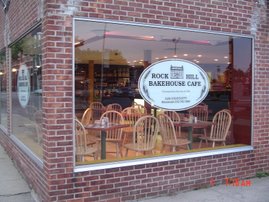
My name is Matt Funiciello. I live in Queensbury, N.Y. and I own and run Rock Hill Bakehouse, a bread bakery in Moreau, New York with a café in Glens Falls. We sell our European breads and biscotti from Manhattan all the way up into the northern Adirondack Park and we regularly employ about 35-40 people. I would like to thank the Committee for this opportunity to “throw my two cents in” where IDA reform is concerned.
I am here today to speak as a small business owner in New York State. I work for a living as do all my employees and we cannot afford a lobby group nor do we participate in the collective efforts of groups like the Chamber of Commerce or the NFIB whose agendas too frequently are tied to that of large businesses like big-box stores and fast food franchises and local manufacturers and not from a place where the best interests of whole communities are the priority.
In this exceedingly poor national economy, it seems that these “small business” lobby groups are not the only ones forgetting their mandate to represent all the people. Our government is racking up record taxpayer debt printing money left and right and handing it out to companies that have never, historically, passed any benefit derived on to their workers or customers.
Bailouts and “stimulus packages” aside, we need to fight these giveaways wherever and whenever possible. It is my feeling that Industrial Development Agencies are an excellent place to start. We need to take a good look at what exactly these groups are doing and how to strengthen oversight and ensure that there is transparency of process.
A great example of the overall ineffectiveness of governmental economic development lies just 15 miles north of here in Malta. New York State has promised Advanced Micro Devices (AMD) a package of benefits that is about 1.2 billion dollars to build a micro-processor plant. I almost feel silly complaining about the much smaller amount given to AMD in sales tax breaks by our local IDA but it certainly seems superfluous (even ridiculous) given the totality of the package. According to a recent article in the Schenectady Gazette, the Saratoga County IDA will be giving what amounts to a 27 million dollar break on sales tax for AMD’s building materials.
Now, let’s think about this for a minute. AMD has lost money three quarters in a row, losing almost as much money as they will be spending to build this new facility. If you were a bank and an entity that is clearly struggling and is clearly not profitable came to you for a loan, what would you do? As a representative of a business that has been steadily struggling to survive for over twenty years, I can tell you what the bank would do.
What if, to compound this company’s undesirability, they are also in direct competition with overseas companies whose costs of production are exceedingly low? Thanks to NAFTA and our ensuing trade agreements, our hard-fought American labor and environmental standards now stand solidly in the way of a company like AMD being competitive against international manufacturers and, to my knowledge, no AMD representative has yet explained how they plan to compete against workers in Asia and India where micro-chips are made for a mere fraction of the cost stateside. What would a bank do?
Now, unlike a bank, our state, facing serious economic times, seems to have left common sense behind and joined hands with the first major player to come along and ask for a handout in a desperate attempt to jump start our economy and create some new jobs. That’s simply not what any responsible business entity would have done. This is far too great a risk and it’s hardly an effective business plan for New York.
The saving grace of such one-sided deals is supposed to be job creation. Our 1.2 billion dollar gift is to be balanced by AMD’s creation of somewhere between 800 and 1465 new jobs in our area. I think that the rare point on which we can all agree (where corporate welfare projects are concerned) is that the development of new jobs is a good thing. But, are all these jobs actually created? Are these always good jobs? Sustainable jobs? When we give IDA breaks to WalMart, what kinds of jobs are we creating? Are these full-time, well-paying jobs or part-time, minimum wage jobs? Many times these “new” jobs are actually just the rehiring of workers whose jobs have been lost when their area’s new WalMart squeezes their employer out. Again, this displacement is hardly a recipe for success by any reasonable measure.
Let’s get out our calculators and do some simple math where AMD is concerned. How much is each of these 800-1465 jobs going to cost us? That’s the simple formula we taxpayers use to determine if a giveaway like this has some merit or amounts to more graft. Now, let’s see … 1.2 billion dollars divided by 800 jobs equals approximately … 1.5 million dollars per job! And, if AMD were able to meet its most recent (higher) estimate of 1465 new jobs, these jobs would drop down to a mere subsidy of $800,000 per job.
Now, you’ll forgive me if, as a business owner, I have to wonder just how good these jobs are going to be? How could anyone with elementary school math skills see this handout as being worth an investment even approaching these amounts?! As a taxpayer, I have to wonder where everyone’s calculators were the day these decisions were made?
Does New York State really feel that these jobs, which might pay, on average, in the low $40,000’s, are actually worth between $800,000 and $1.5 million apiece? If we really do feel that this is the case, can all businesses that have created jobs in the past ten years stand in the same line as AMD and collect our checks for job creation? I think I can speak for the whole small business community in saying that we are more than amenable to bargaining and I’m pretty sure we would ask far less for our services than you’re offering AMD in this instance.
Now, the absolutely incredible amount being offered is the entire package being given to AMD (or the Foundry Company or ATI or whatever you’d like to call them), but we are not here today to talk specifically about that huge amount. We are here instead to discuss IDA reform in our state. How does AMD’s deal tie in to this, mister business owner, you may ask? Well, there’s plenty of IDA money in this deal. It is just so dwarfed by the massive handout package that it easy to forget about it. I simply wanted to preface my remarks about the IDA portion of this contribution with an entire understanding that this company is already getting what most would call an insane amount of support from taxpayers. The IDA money seems to be adding insult to injury. This case makes obvious the need for reform for exactly that reason.
The IDA money being offered in this case is small but, in its own right, it’s still an amount that is pretty hard to justify. That’s exactly why I quoted the whole amount first … so that we can put this whole thing in perspective. The Saratoga County IDA is giving 27 million dollars in sales tax relief to this project. That amounts to about $18,000 - $34,000 per job depending on which of the job projections prove most accurate. The same question applies. Why? And, what jobs could possibly be worth even these lesser amounts given the entirety of the deal the state has handed out?
As a business owner, I have watched for over twenty years as tax money is regularly doled out mostly to the local businesses that seem to need it least. Some of these companies actually seem to exist solely because of the support extended them by the taxpayers through our elected officials.
The AMD case is simple. When you are giving someone 1.2 billion dollars, is it really necessary to rub the taxpayer’s nose in it by taking another 27 million dollars that could go to develop small or sustainable businesses instead? Isn’t that the mandate of the IDA? Why then, do so many projects that involve IDA seem to fail or never meet their forecasted projections for revenue or job creation? There is no end to the number of cases of flagrant abuse by IDA’s across the state. We all know the ones in our own area. AMD is not the only one in mine. There are two more great examples.
Perhaps, the most flagrant abuse of IDA funds in my back yard is the case of the Hudson Falls trash plant in 1991. Now, I know what you’re saying. How could that be a loser? How could anyone lose money by burning garbage and reselling the power it generates to National Grid? Well, to find a case in point, we need look no further than the $86 million in IDA bonds used to build this incinerator in Hudson Falls that was meant to serve Saratoga, Washington, Warren and Essex counties.
Opposition to the plant was loud and articulate and continuous. Now, to a layman like me, this is simple ... burning garbage is frowned upon not only because releasing unknown toxins into the atmosphere, filtered or not, is quite likely unhealthy for the environment. In fact, this is the main reason why it is illegal! But that’s a common sense argument and I am certainly not a corporate scientist trying to justify building a burn plant so I claim no expertise. That said, the studies are still a long way off that will show the cumulative negative impacts of having allowed this project to happen in my backyard so, let’s pretend for a moment that we can’t with any degree of certainty determine that there are increased rates of cancer and water and air pollution in our area as a result of burning garbage. Let’s pretend that there’s no environmental issue here and let’s stick to matters financial in nature (no pun intended).
Critics of the “burn plant” stated loudly and clearly that a garbage incinerator of similar size anywhere else in the country could be built for about 1/3 of the $100 million being floated as necessary. They were ignored and reviled and many of them were even slapped with lawsuits.
Critics also said that there was nowhere near enough garbage being produced in these four counties to allow a burn plant to ever be profitable. They said that it would never be at capacity nor would it be ever be able to meet its job projections. Therefore, they said, it would need constant taxpayer support to survive. As it turns out, these critics were absolutely right. Essex and Saratoga counties refused to play ball and wouldn't sign contracts to use the plant.
According to a recent story in the Glens Falls Post-Star by Blake Jones, Wheeler Foster, the previous operator of the burn plant, regularly saw a $7 million shortfall in revenue which is passed along to “We, the people” (taxpayers). This reporter also wrote that even though last year’s tonnage was a record number, thus far, the trash plant has yet to see a profitable year. The current operator, Wheelabrator, said that in this time of recession it is highly likely that they will see an overall decrease in tonnage next year.
So, in short, everybody knew what a boondoggle this project was except those who were on the Warren/Washington County IDA board at the time. They simply refused to listen to reason and they have cost the taxpayers literally tens of millions of dollars. This lack of common sense and the abundance of ulterior motive to be seen in this case simply beg us to reform the process so that other communities can be spared the kind of pain this entity has wrought.
Another example of abuse in our area is Six Flags. Storytown (aka “The Great Escape”) was purchase by Six Flags in 1994 from its founder, noted philanthropist, Charles R. Wood. He was certainly considered by most to be the very definition of a good neighbor. There is a theater and a hospital wing and a camp for sick children and more than a few museums and charities that owe their very existence to him and his vision of community.
When Six Flags entered the picture, this changed dramatically. For over two years, the theme park collected sales tax only on its admission fee (which it set at a nominal amount, several dollars if memory serves). Its ride fee was tax-free (this amount was over $30). The catch was that you can only collect sales tax this way if the two fees are kept separate and if the admission ticket may be purchased alone. This was not the case. You could only buy the two tickets in concert. By NYS tax code, that makes the whole amount taxable. For two years, the Great Escape only collected pennies when it should have been collecting dollars. It is likely that their little shell game cost Warren County and the state millions of dollars in sales tax revenue.
Eventually, prompted by a very persistent local activist, our state Senator and the NYS Department of Taxation and Finance stepped in to investigate the matter. In the end, they decided not to pursue the sales tax that had gone uncollected and I had to wonder … if I purposely under-collected sales tax for two years on coffee to make my prices seem lower, would the state of New York have forgiven me this transgression as well?
I relate this again as mere background. How does this involve the IDA? Well, my point is that this is a bad neighbor. This is not someone who deserves to be rewarded with taxpayer handouts. Nonetheless, what comes next in my little diatribe is that the Warren County IDA helped this bad neighbor, Six Flags, by using a $1.2 million IDA bond to help Six Flags refinance their mortgage on a brand new water-park! Can you imagine how upset taxpayers are who are paying attention? How could the IDA even consider allowing this corporation to benefit from a taxpayer subsidy? Can you imagine how upset other hotels and parks in the area are that this huge corporation is being given all this free money while the rest of them struggle to survive? Is this fair?
To sum up, based only on the three cases I have outlined, there is an absolutely desperate need to reform the way IDA's function within our state and I urge you to support said reform.
We need to use common sense when handing out IDA assistance and when deciding who gets said support. We need better accountability and more transparency in the process. Without these things, the IDA in New York is just an easy way to funnel taxpayer money into the hands of people who do not truly deserve it.
If we want a stronger and better economy, we do need new jobs but we can’t be so quick to take whatever comes our way. We have to discriminate and we have to set standards for wages and working conditions and the purchase of materials to ensure that the projects in question benefit our state. We need better accountability. If an entity does not meet its agreed job creation goals after receiving an IDA incentive package, there needs to be transparency and enforcement and recourse. Too often, it seems that oversight is lacking and boondoggles like those I’ve referenced are the norm.
Thank you,
Matt Funiciello
Owner / Baker
Rock Hill Bakehouse
Showing posts with label small business. Show all posts
Showing posts with label small business. Show all posts
Wednesday, March 4, 2009


Friday, January 9, 2009
The Green State of the State - Single Payer Health Care
The State Green Party invited me to attend a press conference in Albany to respond to Governor Patterson's State of the State. Here is a link to WNYT's coverage and below is a text copy of my remarks.
http://wnyt.com/article/stories/S735158.shtml?cat=10114
My name is Matt Funiciello. I am the owner of a bread bakery and cafe in Glens Falls, N.Y. I currently employ 36 people. I am here today to deliver my own brief state of the state from a small business owner’s perspective. This is not the perspective of a lobby group purporting to represent small business. It is the perspective of someone who has actually run a small business in New York state for over 20 years.
As this economic downturn began, small business owners, like the majority of Americans, saw substantial increases in energy costs and commensurate increases in most other goods and supplies. In my industry, we were already struggling with the negative impact of increasing wheat prices as corn subsidies encouraged many wheat farmers to grow corn for ethanol. This created a terrible “food for fuel” quandary in which the corn lobbies seem to have been the only clear winners.
While our costs have steadily increased so has the cost of living for our workers. Even so, we have not been able to make pay increases to keep up with cost of living as our sales have been in decline. We were actually forced to implement a small pay cut in September of 2008 and I was eventually forced to sell my home and borrow a substantial sum of money to keep my business afloat as the year progressed and we suffered the additional negative effects of a fire.
We ceased carrying health insurance about a year ago as costs skyrocketed along with co-pays and pharmaceutical prices. We had to discontinue our retirement plan as we were no longer able to afford to participate in it. Many of our restaurant and retail accounts have been adversely affected as well by decreased consumer spending. Several long-time customers have even thrown in the towel.
I say all of this not as some kind of litany of woes but as an example of what the typical business owner is actually going through. We are a tough bunch and we will make it but, make no mistake, we are hurting. If you wish to understand the direct impact the recession is having on those in the working and middle class, look no further. We have tightened our belts, cut costs and minimized our needs, but we are still prepared to sacrifice more if we have to. We would, however, like to know that every single person in the state is joining with us in this suffering and sacrifice and that we are not being asked to shoulder the burden entirely.
Governor Patterson said yesterday that, “We cannot solve our problems overnight or without sacrifice - they run too deep for that. These problems may last for many more months or even years. But we can solve them and, with courage, we can craft a brighter, smarter future for New York.”
I agree with those sentiments, but I think we need to put a little bit of common sense in there before we continue with the sacrifice.
I don’t know about your economy but bailing out banks and insurance companies seems to have had very little impact on mine, thus far. I know that the Wall Street bailout was hardly Governor Patterson’s doing but I know that it is a perfect example of why we HAVE to find answers at the state level for the problems of the day. We simply cannot depend on the federal government to do what is right or just when things are broken.
If we leave it up to the fed or follow their lead, the problems New Yorkers are now facing will go unsolved. The biggest problem, without any doubt, is health care. In fact, according to a recent survey conducted by the Business Council of NY, health care is the single biggest issue for business owners in New York State. Worker’s comp rates came in a distant second.
Governor Patterson says we “need the courage to balance our budget as well as our priorities.” Well, he is absolutely right and small business has spoken loudly about the priority; it is health care. The question becomes, How do
we balance our budget while insuring the millions of New Yorkers who lack coverage?
I know the answer and, in reality, so does the Governor. That’s why I was absolutely horrified yesterday to see him openly advocate for more bureaucratic and incremental answers to our health care crisis rather than the sweeping reform we so desperately need.
Where health care is concerned, there is one clear answer and it is Single-Payer Health Care. It is basically the Canadian Health Care system with a few twists. It’s a clear and intelligent answer to a pressing problem. The Governor’s advocacy for building additional bureaucracies in our state with substandard care and inconsistent access is not such an answer. We need to get rid of the HMO’s and administrate our state’s health care through one mechanism instead of the hundreds that currently exist. It is projected that just that one bold move would save us 25-30% of what we currently pay for health care.
The Canadian system costs about $5200 per person with universal coverage and if you question its efficiency, you should know that, propaganda aside, Canadians live a full year longer than we do. You should also know that no sober, literate, Canadian would even consider switching health plans with anyone living in the U.S. unless they were forced to at gunpoint.
Here, in the U.S., we spend about $7200 per person on health care. Bear in mind that this is with about 60 million people completely uncovered and another 50 million or so ‘underinsured’. With all the layoffs projected from the recession, these numbers will increase dramatically. The incredible truth is that if we adopted Single-Payer Health Care in this country, we would actually be spending far less on care and everyone would be covered. It’s really a common sense approach to the problem.
Thanks to John Conyers and Denis Kucinich, there is already a resolution before congress, HR 676, which does have sponsors, but we need to be realistic about its chances in Washington. The resolution is unlikely to pass. There is simply too much HMO and pharmaceutical money floating around the Capitol for our public servants to do what is just. Many people think of my congresswoman, Kirsten Gillibrand, as a progressive of some kind. She, just like Barack Obama, and now New York’s Governor, has refused to discuss single payer at any level and has refused to support HR 676 even though she knows it is the best, most economical answer.
With our federal representatives doing such a poor job of representing us, we need Governor Patterson to help us resolve this issue right now, right here at home. We can have a single-payer system right here in New York state. We are projected to spend some $140 billion dollars in this state on health care in 2009. If we were to set up a single-payer health plan and spend a similar amount to what the Canadians do per capita, we would be saving $1,800 per person over what is already being spent with EVERY New Yorker covered. Who knows? Maybe we could start living a year longer, too!
Governor, business leaders are telling you that health care is the single biggest issue on the state's agenda but we can also tell you that there is a simple solution. Now is the time for our state government to implement solutions that actually make sense and not just those that seem politically feasible. We have suffered enough. Our workers have suffered enough. How, as a state, can we lose? How can it not make sense to save boatloads of money during a recession while ensuring that every citizen of New York has total access to health care?
The Governor called this recession “the gravest economic challenge in nearly a century.” Well, it seems to me that it really doesn’t have to be if we can just make decisions together which benefit everyone in our state and not just special interest groups and lobbies. Please, Governor Patterson, do what is right and support single-payer health care. Support common sense
http://wnyt.com/article/stories/S735158.shtml?cat=10114
My name is Matt Funiciello. I am the owner of a bread bakery and cafe in Glens Falls, N.Y. I currently employ 36 people. I am here today to deliver my own brief state of the state from a small business owner’s perspective. This is not the perspective of a lobby group purporting to represent small business. It is the perspective of someone who has actually run a small business in New York state for over 20 years.
As this economic downturn began, small business owners, like the majority of Americans, saw substantial increases in energy costs and commensurate increases in most other goods and supplies. In my industry, we were already struggling with the negative impact of increasing wheat prices as corn subsidies encouraged many wheat farmers to grow corn for ethanol. This created a terrible “food for fuel” quandary in which the corn lobbies seem to have been the only clear winners.
While our costs have steadily increased so has the cost of living for our workers. Even so, we have not been able to make pay increases to keep up with cost of living as our sales have been in decline. We were actually forced to implement a small pay cut in September of 2008 and I was eventually forced to sell my home and borrow a substantial sum of money to keep my business afloat as the year progressed and we suffered the additional negative effects of a fire.
We ceased carrying health insurance about a year ago as costs skyrocketed along with co-pays and pharmaceutical prices. We had to discontinue our retirement plan as we were no longer able to afford to participate in it. Many of our restaurant and retail accounts have been adversely affected as well by decreased consumer spending. Several long-time customers have even thrown in the towel.
I say all of this not as some kind of litany of woes but as an example of what the typical business owner is actually going through. We are a tough bunch and we will make it but, make no mistake, we are hurting. If you wish to understand the direct impact the recession is having on those in the working and middle class, look no further. We have tightened our belts, cut costs and minimized our needs, but we are still prepared to sacrifice more if we have to. We would, however, like to know that every single person in the state is joining with us in this suffering and sacrifice and that we are not being asked to shoulder the burden entirely.
Governor Patterson said yesterday that, “We cannot solve our problems overnight or without sacrifice - they run too deep for that. These problems may last for many more months or even years. But we can solve them and, with courage, we can craft a brighter, smarter future for New York.”
I agree with those sentiments, but I think we need to put a little bit of common sense in there before we continue with the sacrifice.
I don’t know about your economy but bailing out banks and insurance companies seems to have had very little impact on mine, thus far. I know that the Wall Street bailout was hardly Governor Patterson’s doing but I know that it is a perfect example of why we HAVE to find answers at the state level for the problems of the day. We simply cannot depend on the federal government to do what is right or just when things are broken.
If we leave it up to the fed or follow their lead, the problems New Yorkers are now facing will go unsolved. The biggest problem, without any doubt, is health care. In fact, according to a recent survey conducted by the Business Council of NY, health care is the single biggest issue for business owners in New York State. Worker’s comp rates came in a distant second.
Governor Patterson says we “need the courage to balance our budget as well as our priorities.” Well, he is absolutely right and small business has spoken loudly about the priority; it is health care. The question becomes, How do
we balance our budget while insuring the millions of New Yorkers who lack coverage?
I know the answer and, in reality, so does the Governor. That’s why I was absolutely horrified yesterday to see him openly advocate for more bureaucratic and incremental answers to our health care crisis rather than the sweeping reform we so desperately need.
Where health care is concerned, there is one clear answer and it is Single-Payer Health Care. It is basically the Canadian Health Care system with a few twists. It’s a clear and intelligent answer to a pressing problem. The Governor’s advocacy for building additional bureaucracies in our state with substandard care and inconsistent access is not such an answer. We need to get rid of the HMO’s and administrate our state’s health care through one mechanism instead of the hundreds that currently exist. It is projected that just that one bold move would save us 25-30% of what we currently pay for health care.
The Canadian system costs about $5200 per person with universal coverage and if you question its efficiency, you should know that, propaganda aside, Canadians live a full year longer than we do. You should also know that no sober, literate, Canadian would even consider switching health plans with anyone living in the U.S. unless they were forced to at gunpoint.
Here, in the U.S., we spend about $7200 per person on health care. Bear in mind that this is with about 60 million people completely uncovered and another 50 million or so ‘underinsured’. With all the layoffs projected from the recession, these numbers will increase dramatically. The incredible truth is that if we adopted Single-Payer Health Care in this country, we would actually be spending far less on care and everyone would be covered. It’s really a common sense approach to the problem.
Thanks to John Conyers and Denis Kucinich, there is already a resolution before congress, HR 676, which does have sponsors, but we need to be realistic about its chances in Washington. The resolution is unlikely to pass. There is simply too much HMO and pharmaceutical money floating around the Capitol for our public servants to do what is just. Many people think of my congresswoman, Kirsten Gillibrand, as a progressive of some kind. She, just like Barack Obama, and now New York’s Governor, has refused to discuss single payer at any level and has refused to support HR 676 even though she knows it is the best, most economical answer.
With our federal representatives doing such a poor job of representing us, we need Governor Patterson to help us resolve this issue right now, right here at home. We can have a single-payer system right here in New York state. We are projected to spend some $140 billion dollars in this state on health care in 2009. If we were to set up a single-payer health plan and spend a similar amount to what the Canadians do per capita, we would be saving $1,800 per person over what is already being spent with EVERY New Yorker covered. Who knows? Maybe we could start living a year longer, too!
Governor, business leaders are telling you that health care is the single biggest issue on the state's agenda but we can also tell you that there is a simple solution. Now is the time for our state government to implement solutions that actually make sense and not just those that seem politically feasible. We have suffered enough. Our workers have suffered enough. How, as a state, can we lose? How can it not make sense to save boatloads of money during a recession while ensuring that every citizen of New York has total access to health care?
The Governor called this recession “the gravest economic challenge in nearly a century.” Well, it seems to me that it really doesn’t have to be if we can just make decisions together which benefit everyone in our state and not just special interest groups and lobbies. Please, Governor Patterson, do what is right and support single-payer health care. Support common sense
Subscribe to:
Posts (Atom)